 Rashid Minhas
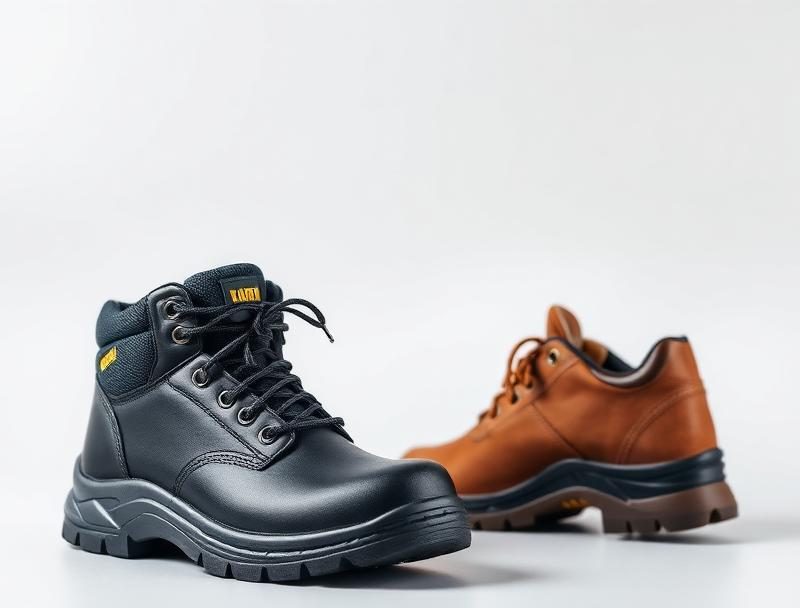
Safety shoes do more than protect feet from falling objects. Depending on their design and certification, they can also offer protection against punctures, slipping hazards, certain thermal conditions and other workplace risks.
For construction companies, manufacturing plants and warehouses, choosing the correct protective footwear is an important part of workplace safety planning.
Yet two pairs of safety shoes may look almost identical while offering different levels of protection.
This guide explains how to choose safety shoes, including the differences between steel toe and composite toe caps, S1P and S3 ratings, and the features industrial buyers in Pakistan should evaluate.
Quick Answer: How to Choose Safety Shoes
Choose safety shoes by assessing the hazards workers face, including falling objects, sharp materials, wet surfaces and heat. Compare the footwear's certified protection category, toe-cap material, penetration resistance, sole performance and fit. Steel toe and composite toe shoes can both provide certified impact protection, while S1P and S3 ratings describe additional protective features.
1. Identify the Hazards Before Choosing Safety Footwear
Not every industrial workplace requires identical safety footwear.
A worker handling heavy materials may need impact-resistant toe protection, while someone working around nails or sharp scrap may also require penetration resistance.
Start with the main hazards:
- Falling or rolling objects
- Sharp materials underfoot
- Slippery floors
- Wet or outdoor working conditions
- Contact with hot surfaces
- Electrostatic discharge risks
- Electrical hazards
- Prolonged standing and walking
A useful footwear specification should describe the actual hazards instead of simply requesting "heavy-duty safety shoes."
2. Steel Toe vs Composite Toe Safety Shoes
Toe-cap material is one of the most common buying considerations.
Both steel and composite toe caps can provide certified impact and compression protection when the complete footwear meets the relevant standard.
The main difference is the material used.
| Feature | Steel toe | Composite toe |
| Material | Steel | Non-metallic composite materials |
| Impact protection | Depends on certified design | Depends on certified design |
| Weight | Can be heavier | Often lighter |
| Metal detectors | May trigger detection | Non-metallic toe cap avoids this particular issue |
| Thermal behaviour | Metal conducts heat and cold | Generally less thermally conductive |
| Selection priority | Certified protection and fit | Certified protection and fit |
When Steel Toe Safety Shoes Make Sense
Steel toe footwear is a familiar choice in construction, fabrication, manufacturing and material handling.
It may be suitable when workers need verified toe impact protection and the overall shoe meets the workplace's requirements.
Steel toe caps should not be assumed to make footwear electrically safe or unsafe without checking the complete footwear's specific classification.
When Composite Toe Safety Shoes May Be Preferable
Composite toe footwear can be attractive where lower weight or reduced metal content is desirable.
Some workers prefer non-metallic toe caps for comfort during long shifts, particularly when footwear has been designed to reduce overall weight.
However, the absence of a metal toe cap does not make footwear electrically insulating.
Buying tip: Compare the complete shoe's certified rating, fit and protective features. Toe-cap material alone is not enough to establish suitability.
3. Safety Shoe Ratings Explained: S1, S1P and S3
Safety footwear classifications help buyers understand the features included in a particular model.
EN ISO 20345 is a commonly referenced standard for industrial safety footwear.
Older products may carry markings based on the 2011 edition, while newer products may use the updated classification system.
Understanding Common Ratings
| Rating | Main characteristics | Typical buying consideration |
| S1 | Safety toe, enclosed heel, antistatic properties and heel energy absorption | Dry indoor work |
| S1P | S1 features plus penetration resistance | Areas with sharp objects underfoot |
| S2 | S1 features plus water penetration/absorption resistance in the upper | Environments with occasional moisture |
| S3 | Combines penetration resistance with water-resistant upper properties and additional outsole requirements | More demanding industrial and outdoor conditions |
These descriptions summarise traditional EN ISO 20345:2011 categories. The revised EN ISO 20345:2022 standard introduces more detailed penetration-resistance markings and other changes.
S3, S3L and S3S: Understanding Updated Markings
Under the newer standard, the marking helps distinguish different penetration-resistant inserts and tests.
- S3: Includes a metallic penetration-resistant insert under the updated classification.
- S3L: Uses non-metallic penetration protection assessed with the specified larger test nail.
- S3S: Uses non-metallic penetration protection assessed with the specified smaller test nail.
These distinctions matter because a label reading simply "puncture resistant" may not explain which test was performed.
Also, water-resistant upper materials are not the same as a completely waterproof shoe.
For prolonged wet conditions, buyers should verify whether a separate waterproof performance marking applies.
4. Additional Safety Shoe Features Worth Checking
Slip Resistance
Industrial floors may become slippery because of moisture, oils, cleaning products or loose materials.
Older footwear can carry SRA, SRB or SRC markings, while newer EN ISO 20345:2022-rated models use a revised slip-resistance system.
Check the certificate and manufacturer's description, including which test conditions apply.
No safety shoe is guaranteed to prevent slipping on every surface.
Heat-Resistant Outsoles
An HRO marking indicates a specific hot-contact outsole test.
This can be relevant in selected manufacturing, welding and industrial environments, but it does not make footwear suitable for unlimited exposure to heat or molten materials.
Electrostatic Discharge (ESD)
ESD footwear helps manage static electricity in environments where electrostatic discharge could affect electronic components or controlled processes.
ESD footwear is not the same as electrical-insulating footwear.
Fuel and Oil Resistance
An FO marking indicates a tested resistance of the outsole to fuel oil under the relevant standard.
This should not be confused with general chemical protection.
Ankle Support
Low-cut footwear may offer flexibility and comfort for routine indoor movement.
Mid-cut and high-cut safety boots can provide more coverage and may offer additional support, depending on their construction.
The cut of the shoe should be chosen together with the complete fit and workplace hazard assessment.
5. Choosing Safety Shoes by Industry
Use the following comparison as a starting point for preparing a footwear requirement.
| Industry or task | Main consideration | Footwear features to evaluate |
| Construction | Falling objects, sharp debris and uneven surfaces | Toe protection, penetration resistance, grip |
| Warehouse operations | Material handling and extended walking | Toe protection, comfort, floor-specific slip performance |
| Manufacturing | Equipment, debris and varying floor conditions | Appropriate S1P/S3 features, wear resistance |
| Outdoor maintenance | Moisture and changing surfaces | Water resistance, grip and penetration protection |
| Electronics assembly | Electrostatic control | Verified ESD performance |
| Hot-work areas | Contact with heated surfaces | Suitable heat-performance marking |
This is a selection aid, not a universal certification recommendation. The final footwear specification should follow the actual task and risk assessment.
6. Safety Shoe Models Available in Pakistan
Saif Al Burhan Trading's footwear catalogue includes products from brands such as Safety Jogger, Safetoe and Burly.
The range contains low-cut shoes, industrial boots and selected models carrying S1, S1P or S3 designations.
Examples of listed products include:
| Product | Listed feature | Suitable point of comparison |
| Burly MSI 106 | Steel toe slip-on design | Closure style and basic protection |
| Safetoe L-7296 | S1P SRC designation | Penetration resistance and older slip rating |
| Safetoe L-7163 | S3 SRC designation | Additional S3 protective properties |
| Safety Jogger Climber | S3 mid-cut design | Protection rating and higher-cut construction |
| Safety Jogger Ceres | Women's S3-rated footwear with HRO listing | Fit, protection rating and outsole performance |
Before purchasing, verify the available size, exact marking and manufacturer specification for each model.
Explore the safety shoes and protective footwear collection for available options.
7. Safety Shoes Price in Pakistan: What Affects the Cost?
The safety shoes price in Pakistan varies according to brand, material, protection rating, design and specialist features.
A basic steel toe shoe may have a different price from a model combining penetration resistance, ESD control and an HRO-rated outsole.
Rather than comparing only purchase prices, procurement teams should evaluate:
- Required protective classification.
- Product lifespan under the expected workload.
- Correct sizes for individual workers.
- Comfort during the normal shift.
- Sole suitability for workplace surfaces.
- Replacement and reorder availability.
A higher-priced model is not necessarily the best option if its special features are irrelevant to the job.
Similarly, a lower-cost product may create avoidable risk if it lacks necessary certified protection.
8. Five Common Mistakes When Buying Safety Shoes
Mistake 1: Choosing by Appearance
A rugged-looking shoe is not automatically certified safety footwear.
Check the protective marking and supporting documentation.
Mistake 2: Assuming All Safety Shoes Are Puncture Resistant
Toe protection does not automatically mean the sole includes penetration protection.
Confirm the relevant P, PL, PS or legacy marking.
Mistake 3: Treating S3 as Completely Waterproof
S3 includes particular water-resistance properties, but that is not the same as waterproof membrane protection.
Mistake 4: Confusing ESD with Electrical Insulation
ESD footwear and electrically insulating footwear serve different protective purposes.
Mistake 5: Ignoring Fit and Comfort
Even correctly rated shoes may cause problems when they fit poorly.
Allow workers to check sizing, heel security, toe clearance and comfort before issuing footwear for regular use.
9. A Simple Checklist for Bulk Safety Shoe Orders
For businesses purchasing multiple pairs, prepare a requirement sheet containing:
| Requirement | Information to collect |
| Number of workers | Total pairs needed |
| Work environment | Indoor, outdoor, dry or wet |
| Hazards | Impact, sharp objects, slipping, heat or electricity |
| Protection category | Required verified rating |
| Sizes | Individual size breakdown |
| Preferred brands | Accepted manufacturers/models |
| Delivery | Required destination and timeframe |
This information makes quotations easier to compare and reduces the risk of purchasing unsuitable footwear.
Saif Al Burhan Trading supplies industrial safety products from Karachi and offers a range of protective footwear for Pakistani businesses.
Frequently Asked Questions
Which safety shoes are best for construction work?
Choose footwear based on the site assessment. Toe protection, penetration resistance, grip, fit and relevant water-resistance features are common considerations on construction sites.
Are composite toe shoes as safe as steel toe shoes?
Both can meet the same applicable toe-protection requirements when correctly certified. Differences in material do not, by themselves, determine the protective performance of the complete footwear.
What is the difference between S1P and S3 safety shoes?
Under the older classification system, S1P includes penetration resistance, while S3 adds water-resistant upper properties and further outsole requirements. Confirm the standard edition and full marking of the actual shoe.
Are S3 safety shoes waterproof?
Not necessarily. S3 indicates defined water-resistance characteristics, not guaranteed waterproofing in all conditions. Check for separate waterproof ratings when needed.
Do all safety shoes protect against electric shock?
No. Antistatic, ESD and electrical-insulating classifications are different. Buyers must select footwear specifically rated for the electrical hazards present.
Final Recommendation
Choosing safety shoes is a balance between certified protection, working conditions, correct fit and long-term usability.
For industrial buyers, the most useful comparison is not simply steel toe versus composite toe. It is whether the complete footwear provides the protective features needed for the work.
Explore industrial safety shoes in Pakistan from Saif Al Burhan Trading and compare available models for individual or bulk procurement.
Technical basis: ISO 20345 requirements and Safety Jogger's explanation of the 2022 marking changes. Product examples were checked against the live Saif Al Burhan catalogue.